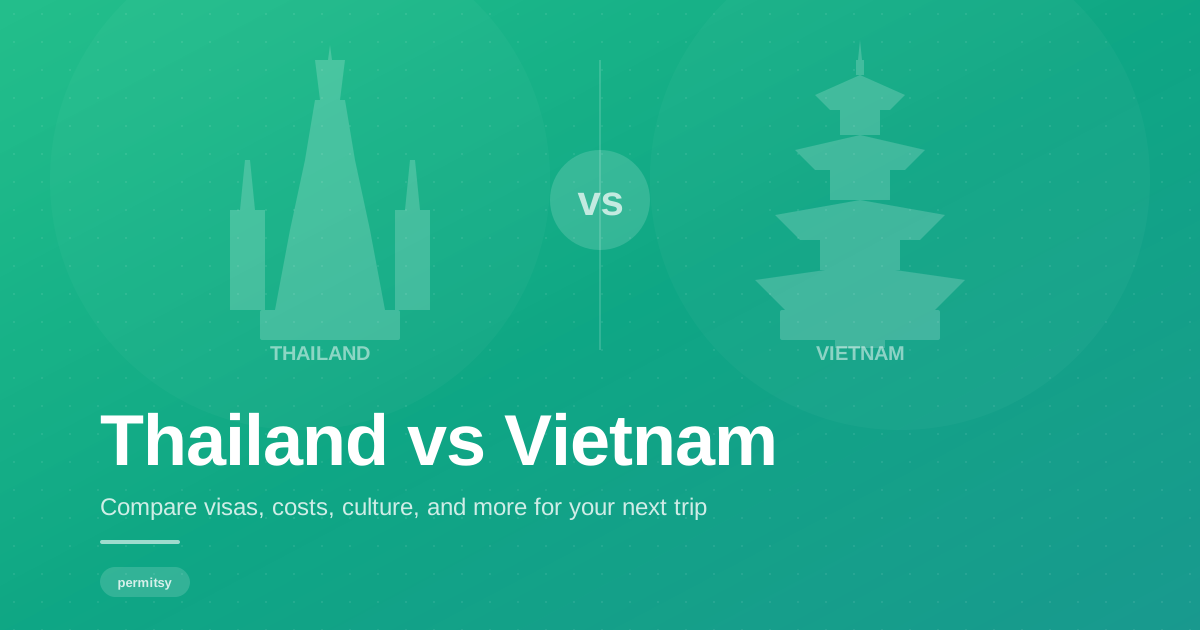
Thailand vs Vietnam: Which Southeast Asian Gem Should You Visit First?
An honest, detailed comparison of Thailand and Vietnam covering costs, visas, food, safety, and top experiences to help you choose your next trip.
The Big Picture
Thailand and Vietnam are two of Southeast Asia's most beloved destinations, and for first-time visitors to the region, choosing between them is a genuinely difficult decision. Both countries offer incredible food, stunning landscapes, rich cultures, and exceptional value for money. But they deliver these experiences in distinctly different ways.
Thailand is the more polished, tourist-friendly option. Its infrastructure is well-developed, English is widely spoken in tourist areas, and the range of accommodation from backpacker hostels to ultra-luxury resorts is unmatched in the region. Vietnam, on the other hand, offers a more raw, adventurous experience. It is less commercialised, more surprising, and often feels more authentically itself. Both are excellent choices, but the right one for you depends on what kind of traveller you are.
Cost Comparison
Vietnam is generally 20 to 30 percent cheaper than Thailand, making it one of the most affordable travel destinations in the world. A comfortable daily budget in Vietnam, covering a private room in a mid-range hotel, three meals, local transport, and a couple of activities, is around USD 35 to 50. In Thailand, the equivalent would be USD 45 to 70. Backpackers can stretch their budgets even further in both countries, with Vietnam dorm beds available from USD 5 and street meals from USD 1.
Accommodation is where the biggest savings occur in Vietnam. A clean, air-conditioned double room in a Vietnamese guesthouse or mini-hotel typically costs USD 15 to 25, compared to USD 25 to 45 for a similar standard in Thailand. Food costs are comparable at the street food level (USD 1 to 3 per meal in both countries), but restaurant dining and alcohol are notably cheaper in Vietnam.
Internal transport is well-priced in both countries. Vietnam's sleeper buses and trains are remarkably affordable, with a Hanoi-to-Ho Chi Minh City sleeper train costing around USD 35 to 60 depending on the class. Thailand's bus and train network is similarly priced, though domestic flights in Thailand are often cheaper due to greater competition among budget airlines like AirAsia, Nok Air, and Thai Lion Air.
Visa Requirements
For Indian passport holders, Thailand offers a visa on arrival valid for 15 days at a cost of approximately 2,000 Thai Baht (USD 57). Vietnam requires an e-Visa, which can be obtained online and is valid for up to 90 days with single or multiple entry. The Vietnam e-Visa costs USD 25 and is typically processed within 3 working days. Both countries require a passport valid for at least 6 months.
Thailand's 15-day VOA is sufficient for most holiday trips but can feel limiting if you want to explore the country in depth. Extensions are possible at Thai immigration offices for an additional 1,900 Baht, granting a further 7 days. Vietnam's 90-day e-Visa is far more generous and allows for extended exploration. For longer stays, Thailand offers a 60-day tourist visa through the embassy, while Vietnam's e-Visa already covers most itineraries.
Best Time to Visit
Thailand's peak tourist season runs from November to February, when the weather across most of the country is cool, dry, and pleasant, with temperatures around 25 to 30 degrees Celsius. The hot season from March to May brings temperatures above 35 degrees, while the monsoon season from June to October brings heavy but usually short-lived afternoon downpours. The southern islands have a slightly different pattern, with the Andaman coast (Phuket, Krabi) best from November to April and the Gulf coast (Koh Samui, Koh Phangan) best from January to September.
Vietnam's weather is more complex due to the country's 1,650-kilometre north-south span. Northern Vietnam (Hanoi, Ha Long Bay, Sapa) is best from October to December and March to April. Central Vietnam (Hue, Hoi An, Da Nang) is driest from February to August. Southern Vietnam (Ho Chi Minh City, Mekong Delta, Phu Quoc) enjoys warm weather year-round, with the dry season from December to April being the most comfortable.
If you have flexibility, November is an excellent month for both countries. Thailand's cool season is beginning, northern and southern Vietnam are in their best weather windows, and tourist numbers have not yet peaked for the Christmas and New Year holidays.
Top Experiences
Thailand's highlights include the Grand Palace and Wat Pho in Bangkok, the ancient temples of Ayutthaya, the jungles and elephants of Chiang Mai, the limestone karsts of Krabi, and the full moon parties of Koh Phangan. Thai cooking classes, muay Thai training camps, and island-hopping boat trips round out a compelling list of activities. Thailand also excels at wellness tourism, with world-class spas and meditation retreats.
Vietnam's standout experiences include cruising Ha Long Bay's emerald waters, exploring the ancient town of Hoi An with its lantern-lit streets and tailor shops, motorbiking the Hai Van Pass between Hue and Da Nang, trekking through the rice terraces of Sapa, and discovering the Mekong Delta's floating markets. The Cu Chi Tunnels and the War Remnants Museum in Ho Chi Minh City offer sobering historical context that adds depth to any visit.
For adventure seekers, Vietnam edges ahead with experiences like caving in Phong Nha-Ke Bang National Park (home to Son Doong, the world's largest cave), motorbiking the Ha Giang Loop through spectacular mountain scenery, and kitesurfing in Mui Ne. Thailand counters with exceptional diving at the Similan Islands, rock climbing at Railay Beach, and zip-lining through the jungle canopy in Chiang Mai.
The Food Scene
Both Thailand and Vietnam are world-class food destinations, and this category is genuinely too close to call. Thai cuisine is characterised by its bold, punchy flavours that balance sweet, sour, salty, and spicy in every dish. Iconic dishes include pad Thai, green curry, tom yum soup, som tam (papaya salad), and mango sticky rice. Bangkok's street food scene was the first in the world to earn a Michelin star (Jay Fai), and Chiang Mai's night markets offer an overwhelming array of northern Thai specialities.
Vietnamese cuisine is lighter, more herbaceous, and often considered healthier. The national dish, pho, is a fragrant beef or chicken noodle soup eaten for breakfast across the country. Banh mi (Vietnamese baguette sandwiches) are a legacy of French colonial influence and arguably the world's best street sandwich. Other essentials include bun cha (grilled pork with noodles), cao lau (Hoi An's signature noodle dish), and fresh spring rolls with peanut dipping sauce.
If you love bold, rich, chilli-forward flavours, Thailand will likely be your preference. If you gravitate toward fresh, clean, herb-driven dishes with nuanced broths, Vietnam may win you over. The honest answer is that both countries will delight any food lover, and eating well is remarkably affordable in both.
Safety and Infrastructure
Thailand has more developed tourist infrastructure, which translates to greater convenience for travellers. ATMs are everywhere, English signage is common in tourist areas, and the public transport network in Bangkok (BTS, MRT) is modern and efficient. Healthcare in Thai cities is of an international standard, with hospitals like Bumrungrad in Bangkok serving medical tourists from around the world.
Vietnam's infrastructure is improving rapidly but remains a step behind Thailand's. Traffic in Hanoi and Ho Chi Minh City is legendarily chaotic, and crossing the street in these cities is a rite of passage for any visitor. English proficiency is lower outside major tourist areas, though the younger generation is increasingly fluent. Healthcare is adequate in cities but limited in rural areas.
Both countries are generally safe for travellers. Petty theft (bag snatching, pickpocketing) occurs in tourist areas of both countries, and the usual precautions apply. Vietnam has lower rates of tourist-targeted scams than Thailand, where overcharging tuk-tuks, gem scams, and jet ski damage scams are well-documented. Both countries have low rates of violent crime against tourists.
The Verdict
Choose Thailand if this is your first time in Southeast Asia and you want a smooth, comfortable introduction to the region. Thailand's infrastructure, English proficiency, and sheer variety of experiences make it the easier and more forgiving destination for first-timers. It is also the better choice for beach holidays, luxury travel, and wellness retreats.
Choose Vietnam if you are looking for a more adventurous, less commercialised experience. Vietnam rewards curious travellers who enjoy getting off the beaten path, engaging with local culture, and embracing a bit of chaos. It is also the better choice for budget travellers, history enthusiasts, and food obsessives who want to eat their way through a country.
The best answer, of course, is to visit both. A classic Southeast Asia itinerary combining two weeks in each country is one of the world's great travel experiences. Wherever you start, eVisaFlex can help you sort out the visa requirements so you spend less time on paperwork and more time planning your adventure.
Need a Visa? Let Us Handle the Paperwork
Skip the confusing government portals and long processing times. eVisaFlex reviews your application for errors, ensures all documents meet requirements, and gets you approved faster.